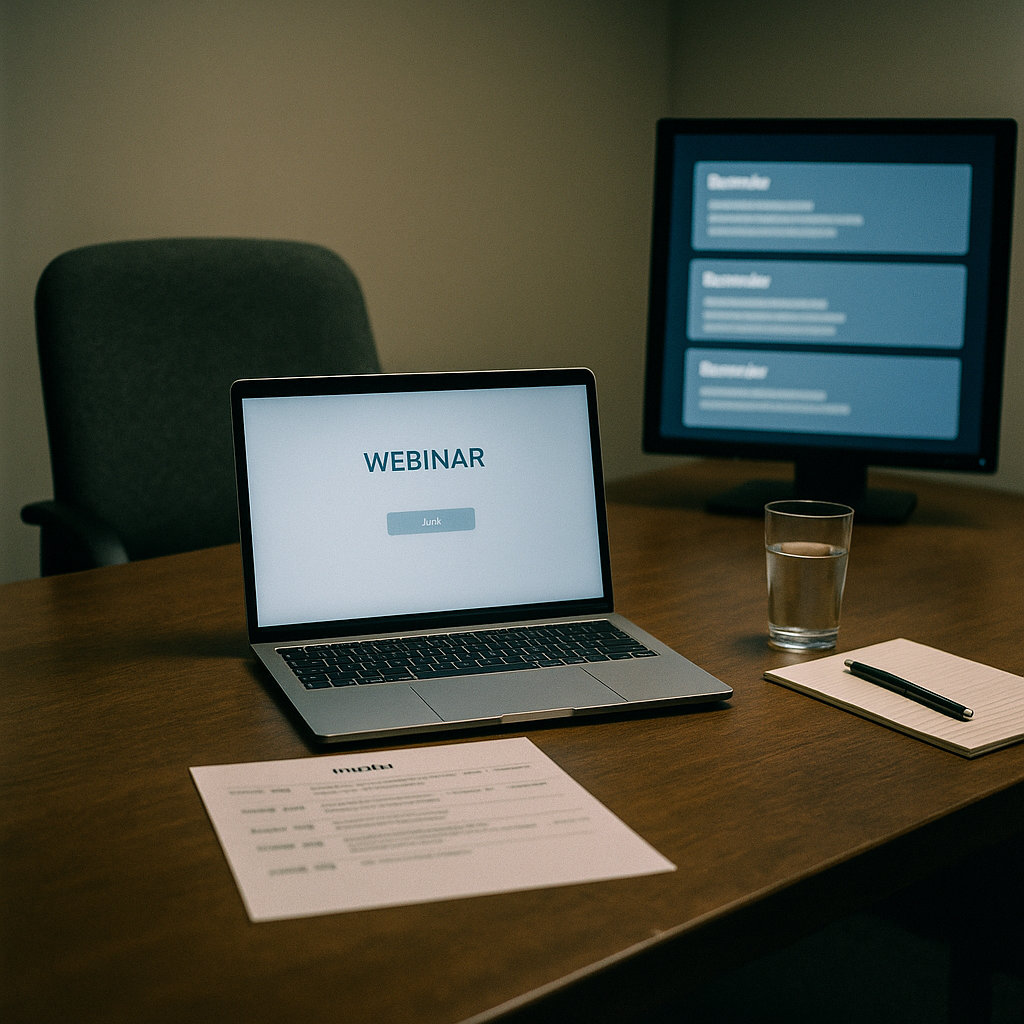
People register for a webinar, the calendar invite lands, and then the last hour goes quiet. The list still looks healthy, but the join room fills slowly, or not at all. That is the gap most teams feel first.
This is why live sessions and join rates need different thinking than registration volume alone. A signup says someone intended to attend. It does not say they remembered, found the link, or still believe the session is worth interrupting their day for.
The mistake is treating the reminder stream like a polite afterthought. In practice, the last stretch before start time carries most of the attendance risk. A generic reminder tool can send messages on a schedule, but if those messages all sound the same, they do not change behavior. They just repeat the date.
The better frame is simple: each reminder has one job. One message should reduce uncertainty. Another should reduce friction. Another should restore context. If you send three reminders that all only say the webinar is coming, you have not moved anyone closer to showing up. You have only increased the number of times they have seen the same fact.
This shows up outside webinars too. The same gap appears when a conference attendee is registered for three sessions but only joins one, or when a sales demo is booked but the prospect never clicks the meeting link. In each case, the signup is not the finish line. It is the start of a memory and attention problem.
That is where the reminder sequence mechanism matters. The point is not to send more mail. It is to change the sequence based on what someone still needs before they appear. A calendar invite helps with timing. A one-hour reminder helps with visibility. A message that restates the outcome helps with motivation. Those are different jobs, and they should not be collapsed into one broadcast.
the hour before the webinar is where intent gets lost
By the time someone is close to start time, they usually do not need persuasion in the abstract. They need one of three things: a reason to care right now, a low-friction path back to the room, or enough confidence that the session will pay off. That is why reminder cadence matters more than message volume.
Manual follow-up often fails here because it depends on someone noticing the drop-off in real time. By the time a coordinator spots low attendance, the window to recover it has already narrowed. Automated sequences are useful because they do the boring part consistently, and consistency is what closes the gap between intent and appearance.
This is also where calendar marketing becomes more than a phrase. A webinar can behave like a scheduled event and a marketing touchpoint at the same time. The calendar entry, the reminder, and the join link are not just operations details. They shape whether the registration is remembered as a commitment or forgotten as a browser tab. calendar marketing works best when the reminders do not just announce time, they keep the event mentally present.
There is no special trick to this. The harder truth is that attendance is usually won before the start button is clicked. It is won when the reminder sequence narrows the distance between yes and show up, instead of assuming the distance will take care of itself.
That is the part teams keep relearning. The registration form is easy to celebrate. The join rate tells the more honest story.
For some teams, the next question is not how to get more signups. It is whether the reminder cadence is specific enough to turn a signup into a real seat. webinar registrations that go quiet before start time is one version of that problem, and it is usually the one that shows up first.