
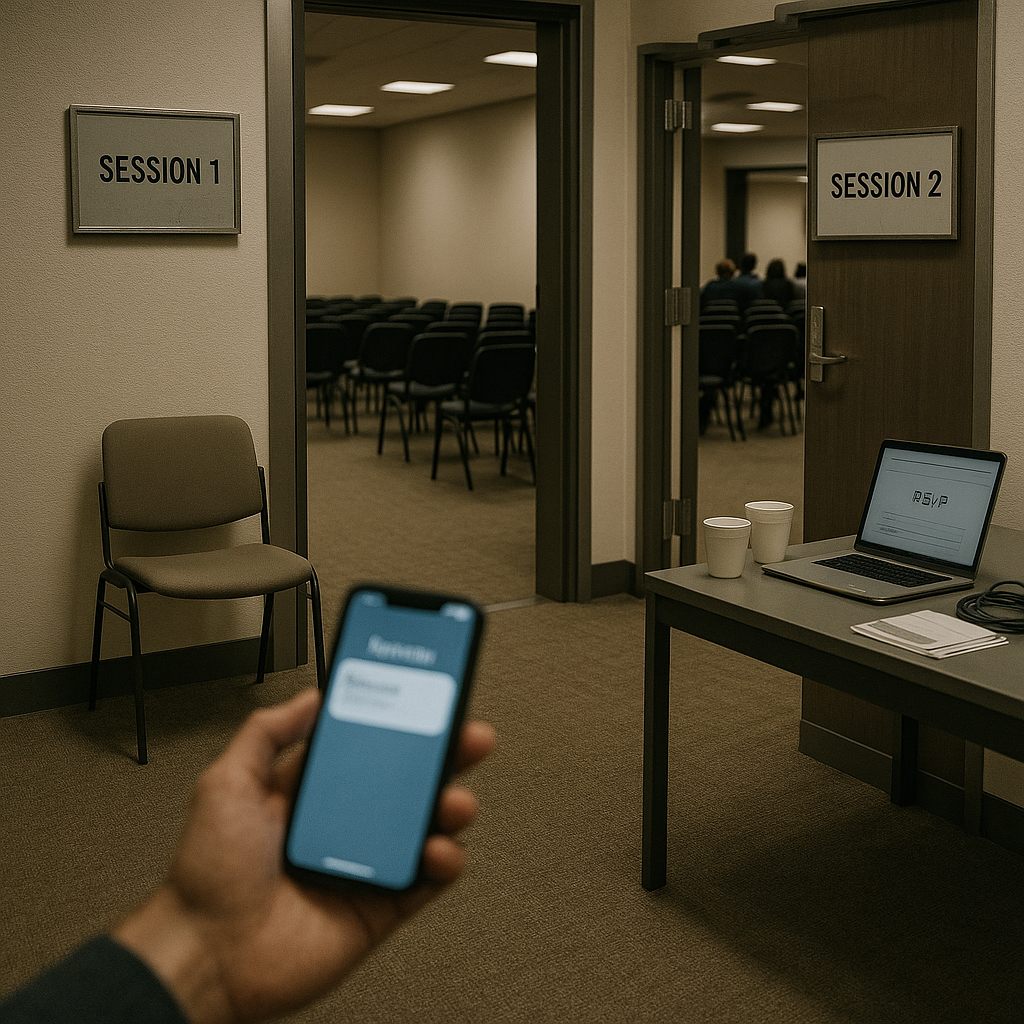
conference session turnout gets shaky when people register for three things and only plan to attend one. The symptom shows up in the same familiar way: the badge scans are lighter than the signup sheet, the morning sessions look better than the afternoon ones, and the second day feels like it belongs to the people who were always going to be there. If you run multi-day, multi-session events with per-session reminders, you know the gap is not just about getting a yes. It is about getting someone to protect a specific hour on a specific day.
That gap matters because conference intent is often shallow in a very ordinary way. People register to keep options open. They want the materials, the networking, the calendar hold, or the sense that they should attend if they can. None of those are the same as deciding, in advance, that room 4b at 2:00 p.m. is where they will be. The same pattern shows up when someone signs up for live sessions and join rates, but conferences make it harder because the decision repeats across sessions, meals, and travel fatigue.
the real unit is not the event, it is the session
One mistake is treating all registrations like one promise. A conference registration is only the first promise. Each session is another. If the agenda is broad, the promise gets diluted. A person may be willing to attend the event in general, but not willing to defend a particular breakout against email, hallway conversations, or the temptation to rest.
This is why generic reminder tools often underperform here. They send the same note to everyone, at the same time, with the same subject line. That is enough to say “the conference is coming,” but not enough to say “your session starts in 45 minutes, in this room, and it is worth leaving your current conversation to get there.” The sequence has to match the decision being made. A registration reminder is one thing. A session reminder is another. the reminder sequence flow matters because each touch has a different job: confirm the event, then confirm the session, then confirm the next step.
That is also why broad event language can fail even when the content is strong. “Join us tomorrow” is vague. “Your workshop on procurement workflows starts in Room C at 10:15” gives the attendee less room to drift. The more choices a person has inside the event, the more specific the reminder has to be. For a conference, specificity is not decoration. It is the thing that turns interest into a plan.
the second day is where intent gets tested
The first day of a conference benefits from momentum. People arrive because they already made travel plans, cleared a block on their calendar, or simply want to see what the event feels like. The second day is different. It asks them to recommit after they have already spent time, energy, and attention. That is why the old pattern of one event reminder and one last-minute note leaves a lot of turnout on the table.
You see a similar effect in conference session rsvps that go stale between days. The RSVP is still technically true, but the intention has gone soft. People do not usually wake up on day two and decide they dislike the conference. They just have more friction in front of them. A bad night of sleep, an early flight, a crowded dinner, a session that ran long yesterday, and suddenly the next session becomes optional.
That is where a reminder sequence does real work. Not by nagging, but by re-establishing the next concrete commitment. The best sequences do not ask, “Are you still coming?” They remind people what they said yes to, when it starts, and why it is worth the trip down the hall or back to the venue after lunch. That is the difference between calendar marketing as noise and calendar marketing as a useful nudge. Used well, calendar marketing is not about pushing harder. It is about making the next action easier to remember than the next distraction.
what event teams should watch instead
If you measure conference turnout only at the registration level, you miss the part where attendance is really won or lost. The useful questions are more specific: which sessions recover well after the first reminder, which ones need a same-day nudge, and which rooms consistently see drop-off after lunch? Those answers tell you more than total signups ever will.
They also tell you where to spend effort. A strong reminder cadence can help, but it cannot fix a session that has no clear audience or no clear reason to leave the lobby. When the content is right, reminders help people act on their intent. When the content is vague, reminders just expose how weak the intent was to begin with.
That is the practical lesson for conference organizers: turnout is not one number, it is a chain of small commitments. The earlier you see that, the less you will mistake registration for attendance, and the more room you have to close the gap before the chairs sit empty.